Elite CVD
AsksWho appears to be pressing harder—buyers or sellers?
Estimates buying and selling pressure from candles and volume, then keeps a running tally.
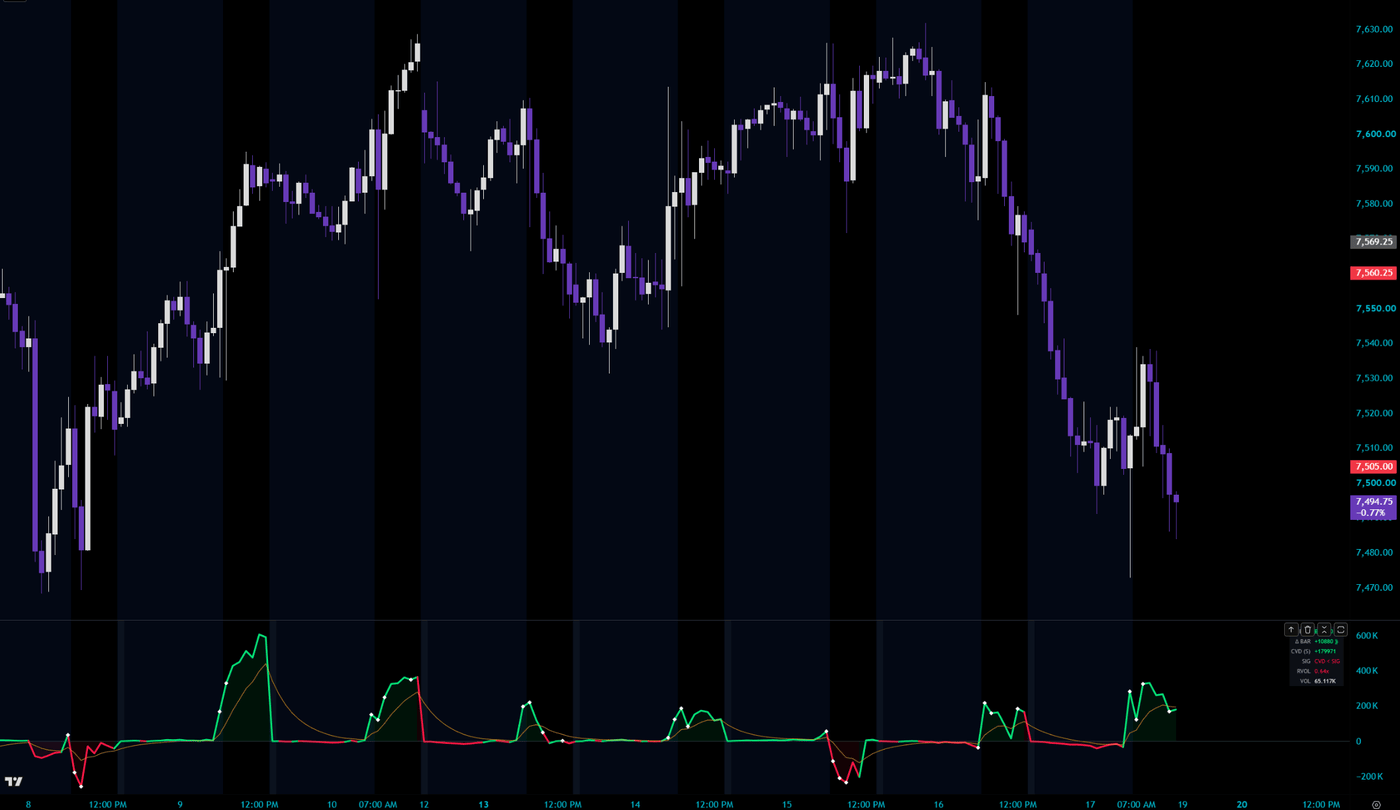
What it measures and how
A cumulative volume delta pane that estimates buying and selling pressure from candle structure and volume. Context-aware wick attribution instead of naive 50/50 splits, session resets so today’s line is today’s flow, RVOL-weighted delta with spike dots, and pivot-based divergences that confess their own confirmation lag.
Plain EnglishIt estimates buying and selling pressure from each bar’s price structure and volume, then keeps a running tally so you can compare that pressure with price.
Get started
- Open the free TradingView script above and add it to a chart with volume data. Check the dashboard and reset mode before reading the line.
- Compare the cumulative line with price within the same reset period. Note whether RVOL weighting is on, because the weighted line is not a share or contract count.
- Treat a divergence mark as a comparison between confirmed pivots. It becomes available only after the required right-side bars; it was not known at the turn itself.
Inputs and settings
Proxy methodContext-Aware (default) splits each bar’s volume by body and wick structure, crediting a set share of the supportive wick to the winning side. Classic Close Location uses only where the close sat in the range. Blended averages the two.
Wick attributionDefault 0.75. The share of the supportive wick credited to the bar’s direction. Raising it makes directional bars read more one-sided; 0.5 makes wicks neutral.
Reset modeSession (default) restarts the cumulative line each exchange day or custom session. Fixed Blocks resets every N bars. Rolling Window is a moving N-bar sum. None runs forever. These are deliberately different semantics, not synonyms.
Signal lineEMA (default, 8) restarts exactly with the reset. SMA and WMA stay hidden until their full window belongs to the new session, so yesterday cannot bleed into today’s signal.
RVOL weightingOn by default: each bar’s delta is scaled by the square root of its relative volume, capped at 6x, with the current bar excluded from its own baseline. Turn it off to read the unweighted volume estimate. The allocation still comes from candle structure, not observed bid/ask executions.
DivergenceConfirmed price pivots only: 5 bars left, 2 right by default, a maximum gap between pivots, and a minimum CVD separation as a multiple of average delta so cosmetic divergences are rejected. Pivots in different sessions are never compared.
When it fails
It is not order flowEverything here is inferred from OHLCV bars. It estimates who was in control from bar shape and volume; it does not see aggressor-side executions. On thin or gappy symbols the inference is weaker than the line looks.
Daily and higher chartsWith Session reset, every daily bar is its own session, so CVD equals the bar’s own delta. Use Rolling Window or None there.
Missing volumeA symbol or feed without volume contributes zero and the dashboard says so. The line will not error; it will simply be flat and mean nothing.
RVOL changes the unitsWhen weighting is on, the y-axis is a weighted quantity, not contracts or shares. Compare shape, not magnitude, across symbols.
Open source, no email wall, no upsell gate. Read the code, test it on your own tape, keep it. Every other tool on the workbench is the same deal: see all 20.
Keep the tool.
Add a second read.
Elite CVD estimates volume pressure from candles and volume. Keep that focused view.
The paid MIZAN engine runs on TradingView. It adds the market read, the score and explained blocked setups for the candidates it detects. Reversal setups that pass get entry, stop and target references.
MIZAN is a separate engine, not a bundle of these free tools. Compare its read with your own method.
See passed setups, blocked setups and losses →
Test it on your tape — 7 days free
7-day trial starts at checkout · From $79.99/month afterward · Cancel through Whop · Manual access within six hours after checkout and receipt of your correct TradingView username