Break Quality
AsksWas that breakout real, or a trap?
Grades the bar that breaks a level, then records whether the break held.
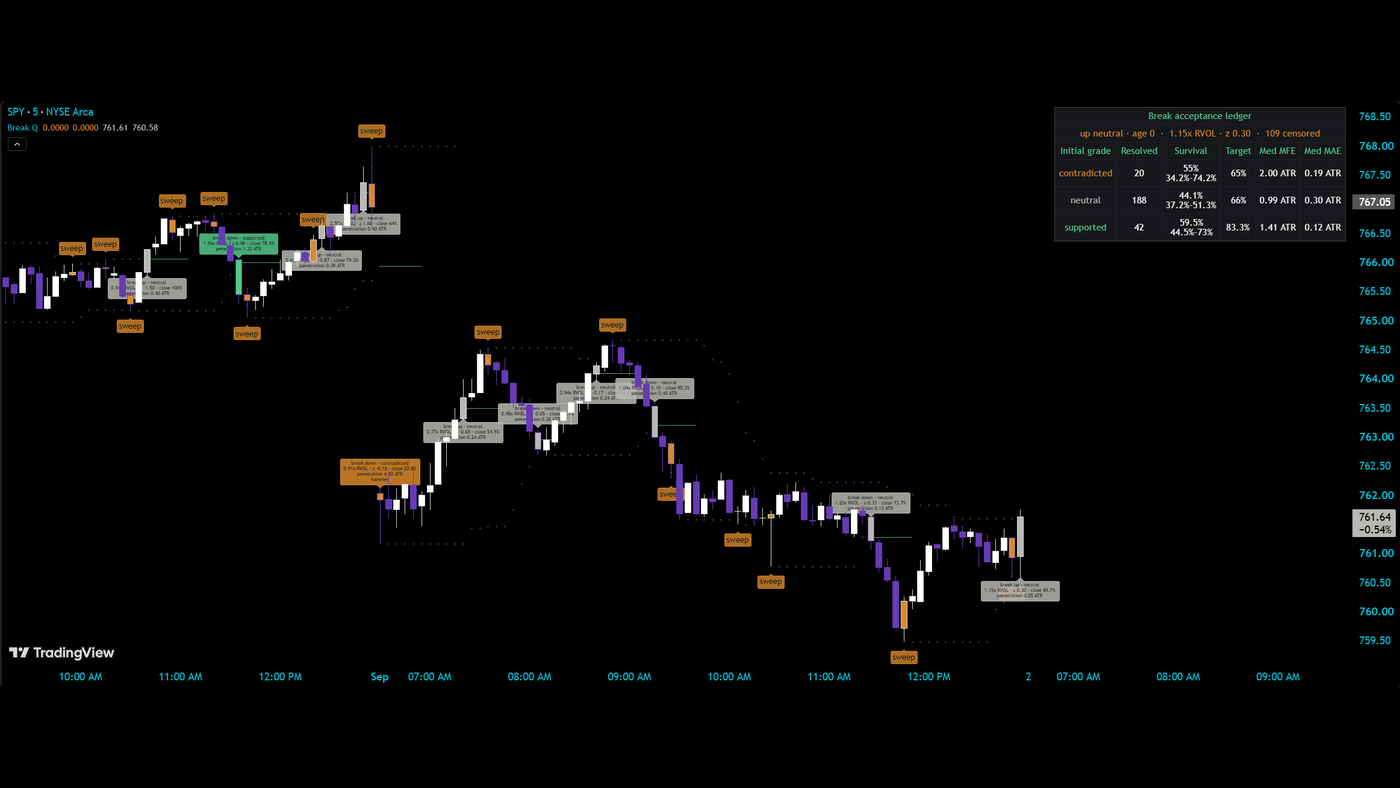
What it measures and how
Price can close beyond a prior high or low and still move back through it later. The close identifies the break; the surrounding evidence and the later outcome answer different questions.So this keeps three claims separate. The event: a confirmed close beyond a known prior level. The grade: was the break bar supported, neutral, or contradicted by its own evidence — participation against a same-clock volume baseline, close location, penetration, and any opposing candle shape.The outcome: did price survive a fixed horizon, or close back through the level. A ledger then reports, per grade, how many resolved, how many survived with a confidence interval, and the median excursion in ATR. Every verdict lands on the confirmed close.
Plain EnglishNo lower pane to check. The grade prints on the bar that did the breaking, the broken level stays drawn, and the ledger in the corner tells you whether supported breaks have actually held better than contradicted ones on this chart. If they have not, it says so.
Get started
- Open the free TradingView script above and add it to a whole-minute intraday chart. Check that the interval aligns with your selected session.
- Find a break label and its drawn level. The label grades evidence on the completed break bar; it does not report the later outcome.
- Compare the ledger rows using resolved counts, survival rates and confidence intervals. Check whether the grades separate on this chart before relying on their distinction.
Inputs and settings
LevelsRolling prior range (excluding the current bar) or confirmed pivots that activate only after right-side confirmation and are consumed once. Break tolerance in ticks or as a fraction of ATR, frozen onto each event when it starts. A directional cooldown stops cascading trend bars from producing an event on every bar.
ParticipationSame-clock robust baseline by default: the median of log volume at this exact time slot across complete prior sessions, with a MAD spread that falls back to the interquartile range. The current bar is excluded from its own baseline. A prior-bar simple average is the alternative.
Grade thresholdsSupported needs participation, close location, body efficiency and penetration to clear their thresholds with no opposing geometry. Contradicted is opposing reversal geometry or a weak close against the break. Every threshold is an input; they are conventions, not calibrations.
Forward evaluationHorizon in bars, target as an ATR extension, one unresolved event per direction. Events still open at a session boundary or the chart edge are censored, never scored, and the censored count is shown.
Drawing budgetsLabel and line limits so older history is not silently crowded out. Sweeps — a wick through a level that closes back inside — are annotated separately from breaks.
When it fails
Both-hit bars get no target creditWhen one bar touches both the target and the invalidation, OHLC cannot say which came first. That bar receives no target credit and no favourable excursion; adverse excursion is still recorded. Upgrading a result needs evidence; downgrading is the default.
Timeframe alignment is strictIntraday, whole-minute charts only, and the chart timeframe must divide the session start and length exactly. For a 09:30 to 16:00 session that is 1, 2, 3, 5, 6, 10, 15 or 30 minutes. Misaligned timeframes are refused with a message rather than measured against fuzzy boundaries.
Half days and gapsVolume history is committed only for complete sessions. Partial first days, early closes and missing bars are excluded whole; the header shows the excluded count. The baseline is thin until enough complete sessions have loaded.
The ledger is the testIf supported and contradicted breaks survive at the same rate on your instrument, the grade is not earning its place there, and the table will say so. That is a feature.
Open source, no email wall, no upsell gate. Read the code, test it on your own tape, keep it. Every other tool on the workbench is the same deal: see all 20.
Keep the tool.
Add a second read.
Break Quality compares individual breaks with their later chart outcomes. Keep that focused view.
The paid MIZAN engine runs on TradingView. It adds the market read, the score and explained blocked setups for the candidates it detects. Reversal setups that pass get entry, stop and target references.
MIZAN is a separate engine, not a bundle of these free tools. Compare its read with your own method.
See passed setups, blocked setups and losses →
Test it on your tape — 7 days free
7-day trial starts at checkout · From $79.99/month afterward · Cancel through Whop · Manual access within six hours after checkout and receipt of your correct TradingView username